

How To Animate A Drawing In After Effects
It'south easy to create your own frame-past-frame animation using Adobe Subsequently Effects' brush tool.
If y'all've e'er looked through a flipbook, you lot accept seen that images with slight differences can create the overall illusion of move. You can use this aforementioned technique of frame-past-frame drawing to create your own animations in Adobe After Effects. Information technology is a tedious procedure, but luckily, it is not difficult! This basic tutorial will teach you the bones method, which can be applied to whatever illustrations you lot would similar.
 An example of animation frames.
 (To larn how yous can apply this play tricks to TikTok videos, click here. Or, want to skip the organic drawing and simply trace over the frames of a video? We accept a tutorial for that, as well.)
- Create a new composition with a solid color layer.
Nosotros are going to use this solid color as our background. Go to Layer > New > Solid to create one with a colour of your option.
- Double-click the brush tool (
 ) to create a pigment layer.
In one case this is created, y'all tin select your paintbrush besides.
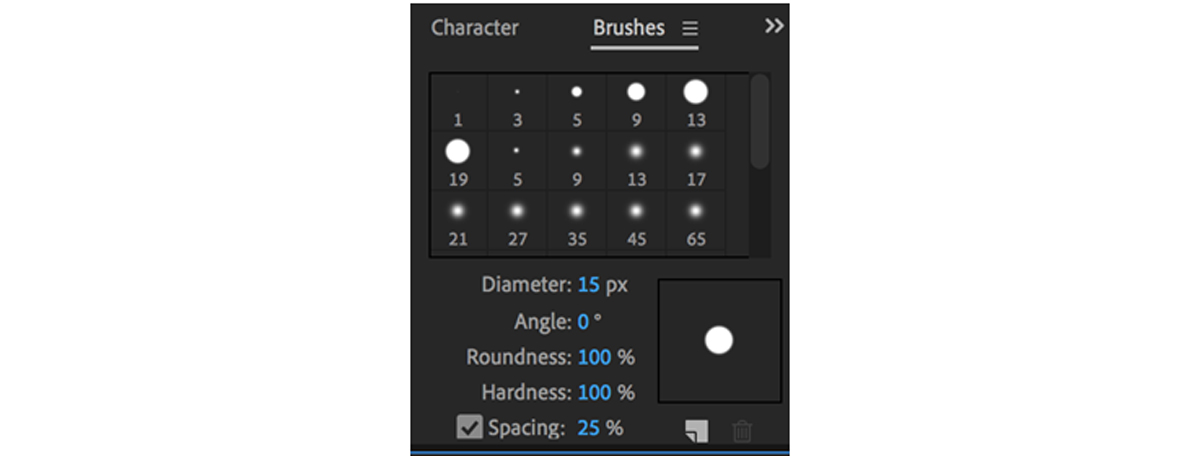
In this example, I am using a elementary, circular 15 px brush in the color white.
- Set the frame duration as a "custom" of 2f.
The duration indicates how many frames of movement your pigment strokes will be on-screen for. 2 is a convenient duration because it allows your frames to overlap for a second—you lot will see how this works after the next couple steps.

- Draw your first frame.
For this example, I am going to depict a curly, moving doodle. The showtime frame might be boring, only the blitheness will look clean if it starts out small!

- Employ the control central and right pointer central to advance to the adjacent frame.
Do this once to motion i frame forrard. Nothing will modify, but describe your second frame on top of the first one. You'll want to use the same color, but for the sake of this tutorial, I used white to show my first stroke and black to show the 2nd.

- Repeat this step until your animation is consummate.
When you press command+right arrow this fourth dimension, you should see only your second brushstroke. Add together your third one on top of this and repeat the stride (Draw your frame, advance 1 frame forward. Draw, advance. Depict, advance.) until your animation reaches its concluding frame.
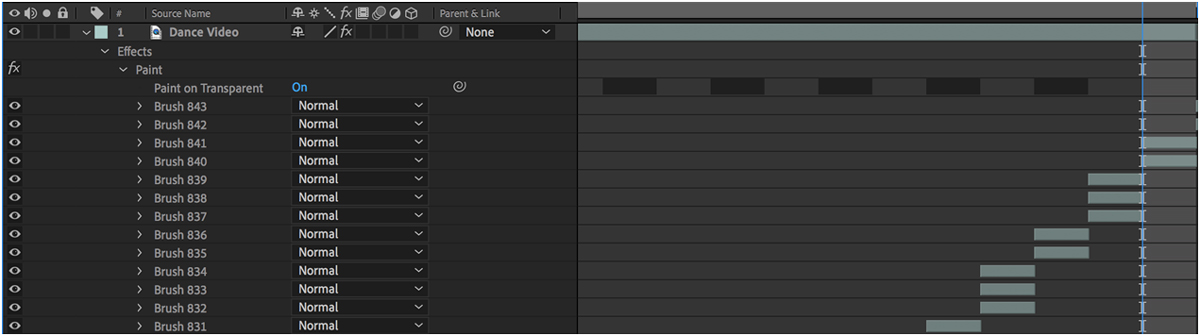
You can move backwards in the timeline past pressing command+left arrow. To delete a brushstroke or change its elapsing, click the down arrow beside "effects" in your timeline window. Open the paint layer. Y'all should exist able to run into all of the brushstrokes yous have created, each spanning the number of frames it occupies onscreen. Curl until you find the brush yous would like to delete or alter. You can delete a brush using your computer'south delete primal or alter the length of a brush past dragging the start and endpoints dorsum and forth in the timeline.
- Click back into the main composition to view your animation.
Close the paint layer by going back to your original composition. The tabs usually appear along the top of your project window. Drag the playhead to the starting time and press the spacebar to watch your animation from beginning to end.


Source: https://makeitcenter.adobe.com/en/blog/frame-animation-after-effects.html
Posted by: lopesleou1984.blogspot.com
0 Response to "How To Animate A Drawing In After Effects"
Post a Comment